
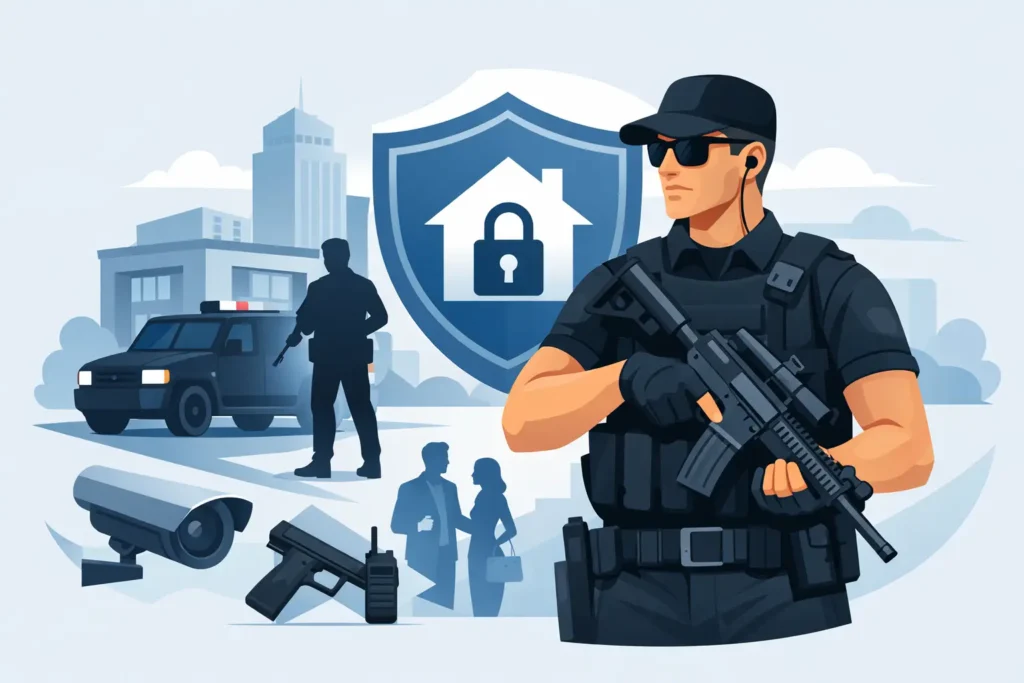
A uniformed officer at your entrance changes behavior fast. For some properties, that visible deterrent is enough with an unarmed presence. For others, the risks are higher, the threats move faster, and the question becomes more urgent: what is armed security, and when is it the right level of protection for your site?
Armed security is a professional security service performed by licensed officers who are authorized to carry a firearm while on duty. These officers are hired to protect people, property, and operations in environments where the threat level, asset value, public exposure, or likelihood of violent confrontation is too high for a standard unarmed presence alone. The role is not about intimidation. It is about deterrence, trained response, and maintaining control during serious incidents.
For property managers, construction leaders, retail operators, and event decision-makers, armed security is usually considered when the consequences of a security failure are significant. That may mean protecting high-value inventory, controlling access at a sensitive facility, securing cash-handling operations, or supporting sites with a history of aggressive trespassing, theft, or violence.
What Is Armed Security in Practical Terms?
In practical terms, armed security places a trained, licensed officer on site or on patrol with the authority to carry a firearm as part of their assignment. That officer may be posted at an entry point, patrol a perimeter, monitor restricted zones, manage visitor screening, respond to alarms, or coordinate with law enforcement during an emergency.
The firearm is only one part of the service. What clients are actually paying for is a higher-response security presence. A qualified armed officer should also bring observation skills, de-escalation training, report writing discipline, radio communication, incident response procedures, and the judgment to act within the law and within post orders.
That distinction matters. Armed security is not simply unarmed guarding plus a weapon. It requires a different level of screening, training, supervision, documentation, and site planning. A reliable provider treats armed coverage as a serious operational commitment, not an add-on.
How Armed Security Differs From Unarmed Security
Unarmed security and armed security both aim to prevent incidents, maintain order, and respond quickly when problems arise. The difference is in the level of threat they are expected to manage.
Unarmed officers are often the right fit for residential communities, office lobbies, parking enforcement, access control, and general patrol duties where deterrence and observation are the primary goals. They handle many situations effectively, especially where customer service, policy enforcement, and routine visibility are the priority.
Armed officers are typically reserved for environments where there is a credible risk of violent crime, armed intrusion, targeted theft, or dangerous confrontations. Think of facilities with valuable assets, public traffic, after-hours vulnerability, or prior incidents that show a stronger response posture is justified.
The trade-off is straightforward. Armed security can provide a stronger deterrent and a higher level of preparedness, but it also carries more liability exposure, stricter compliance requirements, and a greater need for clear operational oversight. It should be deployed because the site risk justifies it, not because it sounds more impressive on paper.
When Armed Security Makes Sense
Not every site needs armed protection. In many cases, an unarmed guard, mobile patrol, access control plan, lighting improvements, and camera coverage are enough to reduce risk. Armed security makes the most sense when the environment presents a higher probability of serious criminal activity or when the impact of a violent incident would be severe.
Commercial properties may need armed officers when repeated trespassing escalates into threats against tenants or staff. Construction sites may require it if they store high-value materials and equipment in isolated areas with a pattern of theft. Retail locations sometimes use armed coverage where there is heavy cash handling, organized retail crime, or a history of robbery attempts. Government-related sites, critical infrastructure, and certain live events may also require a more defensive posture.
Timing also matters. Some clients do not need armed officers around the clock. They may only need coverage during overnight hours, high-traffic periods, payroll days, tenant disputes, evictions, or special events where crowd behavior and access control become less predictable.
A good provider will not push armed coverage where it does not belong. The right recommendation depends on site history, operating hours, public access, asset exposure, neighborhood conditions, and your overall risk tolerance.
What Armed Security Officers Actually Do
The day-to-day work of an armed officer is often more disciplined than dramatic. Most assignments focus on prevention, control, and readiness rather than active confrontation.
An armed officer may control site access by checking credentials, screening visitors, and monitoring delivery points. They may conduct foot patrols or vehicle patrols to identify open doors, suspicious behavior, perimeter breaches, safety hazards, or unauthorized persons. They document incidents, preserve order, and communicate with site contacts in real time.
If an incident develops, their role is to assess, contain, report, and respond according to training and site protocols. That may include verbal intervention, requesting backup, preserving evidence, securing affected areas, and coordinating with police or emergency responders. The presence of a trained armed officer can shorten response time during fast-moving situations where waiting for outside help alone may not be enough.
Licensing, Training, and Accountability Matter
If you are evaluating armed coverage, the most important question is not whether the officer carries a firearm. It is whether the provider operates with the discipline required for armed assignments.
Armed officers should be properly licensed according to state requirements and trained not only in firearms use, but also in legal authority, use-of-force standards, de-escalation, emergency procedures, communication, and incident documentation. Ongoing qualification, supervision, and post-specific instructions are critical.
Accountability systems make a major difference. GPS-tracked patrol activity, digital reporting, supervisor checks, real-time dispatch access, and documented scan points help confirm that officers are where they should be and doing what the post requires. For clients, that translates into visibility, proof of service, and fewer blind spots.
This is especially important in Southern California, where properties and events can have varied threat profiles depending on location, public access, operating hours, and local activity patterns. A disciplined armed security program needs to match the site, not rely on assumptions.
Risks and Considerations Before You Choose Armed Security
Armed security can be the right move, but it should be considered carefully. A firearm increases the seriousness of the post and the expectations placed on the provider. If the company lacks strong hiring standards, site supervision, or clear response protocols, armed coverage can create new problems instead of solving existing ones.
There are also perception issues to consider. In some environments, an armed presence reassures tenants, employees, and customers. In others, it may feel too aggressive if the site does not have a clear risk profile. That does not mean armed protection is wrong. It means deployment should be intentional, explained, and professionally managed.
Cost is another factor. Armed officers usually involve higher rates because of licensing, training, insurance, and the level of responsibility involved. For many clients, that cost is justified only in specific zones or high-risk time windows rather than across an entire property full time.
How to Decide What Your Site Needs
The best place to start is with a realistic threat assessment. Look at your incident history, the type of people accessing the property, whether valuables or cash are present, how exposed the site is after hours, and how quickly local law enforcement can respond. Consider operational needs too. A gated community, warehouse, supermarket, construction site, and live event may all require security, but not the same kind.
For some clients, the right plan is layered security. That could mean unarmed lobby coverage during business hours, mobile patrol after hours, and armed officers only for high-risk periods or sensitive access points. For others, a dedicated armed post is the appropriate baseline because the environment demands constant preparedness.
Boundary Frontline Security approaches this decision the way it should be handled – based on site conditions, threat exposure, and operational realities, not guesswork.
Armed security is best understood as a risk-based service. When the stakes are higher, the security posture has to match. If you are weighing your options, the right answer is the one that protects people, controls liability, and gives your property a security presence that is visible, accountable, and ready when it counts.